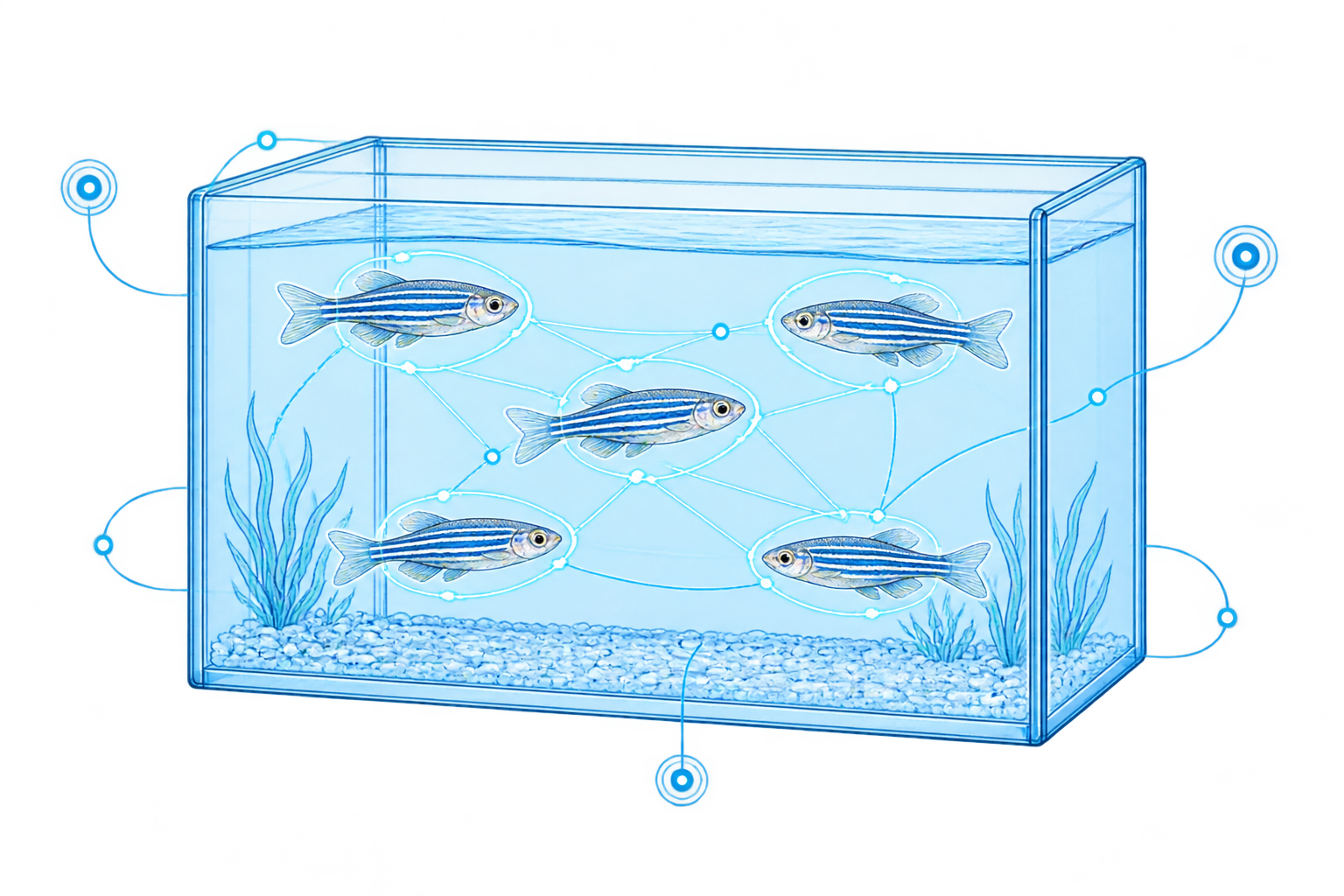
Mimic. Simulate. Detect.
We build a simulated twin of a living system, generate labeled data that reality cannot produce, and train detection against it.
Swarmoscope builds a simulated twin of a living system from calibrated recordings, uses that twin to generate labeled data no one can annotate by hand, and trains detection against it. The twin absorbs the cost of expensive sensing once, so the detection it produces is designed to run on ordinary cameras. The method is domain neutral. What changes between domains is the skill on top.
The loop, not the detector.
Real world data cannot label itself. Position in three dimensions, identity through occlusion, state under conditions that occur a few times a season: these are the labels that decide whether detection works, and they are exactly the labels a human annotator cannot supply. A simulated twin can, because it knows the answer before it renders the frame.
That is what makes the economics work. Expensive sensing becomes a one time training cost at a single instrumented site instead of a per unit cost repeated at every site you deploy to. Biological monitoring markets are low margin and geographically spread. That inversion is what makes them addressable at all.
The detector is the visible part. The loop that produced it is the part that is hard to copy.

One platform, swappable skills
The platform is domain neutral: simulator engine, training machinery, inference runtime. It does not know what a fish is. A skill is what makes the platform useful in one domain, and a skill is always a claim that can be proven wrong. We name the claim before we build the skill, so it can be tested rather than asserted.
From a real site to detection that runs on ordinary hardware
Swarmoscope structures the path from a real recorded environment to deployed detection, as a repeatable workflow rather than a bespoke project for each domain.
Build the twin
Calibrated recordings of a real site become a simulated twin that reproduces how the real system actually moves, not how it is assumed to move.
Generate labeled data
The twin produces labeled data at scale, including the rare conditions field observation seldom yields, with ground truth known by construction rather than by annotation.
Deploy on ordinary hardware
The model is trained against the twin, validated against real footage, then deployed on hardware the site already has.
Built for teams that need detection where annotation is impractical, from the laboratory to the field
Preclinical and Discovery Teams
Continuous behavioural readouts from live animals, measured across a whole group over days rather than at a single endpoint. Built for groups where the limiting factor is quantifying and automating the response, not the model itself. Zebrafish is the active skill and is at proof of concept.
Simulation and Synthetic Dataset Partners
Purpose built simulation environments and synthetic labeled imagery for detection tasks in visually hostile conditions, delivered as output artifacts.
Growers and Agronomy Teams
Biological state from sensing that is already in the field, turning existing installed hardware into a source of state rather than a source of counts.
Aquaculture
Fish in a production cage are a swarm under conditions that change daily, and the labels that matter, position in three dimensions, identity through occlusion, and state during rare events, are exactly the labels no annotator can supply.
A calibrated twin of a stocked volume generates labeled data covering conditions that occur a few times per cycle, so detection can be trained for events that field footage almost never captures cleanly.
Expensive sensing is paid once at one instrumented site, and the resulting detection is designed to run on cameras already installed on the farm, which matters in a market that is low margin and geographically spread.
Behavioural state can be recovered from the cameras already operating on a farm cage, trained only on data the twin produces.
A rare event class that field footage almost never captures cleanly can be detected after training solely on the twin.
Counting and biomass estimates produced by the twin-trained model agree with reported numbers closely enough to act as an independent check, not a replacement.
No aquaculture skill is active. The platform capability is what transfers, and any claim here would need to be validated against real farm footage before it is stated as a result.
What is working today, and what is still open
Phase 1 is closed end to end on a live tank: calibrated stereo capture, refraction corrected reconstruction, and a running simulated twin driven from an external controller in real time. The round trip from real recording to twin and back holds without accumulating error.
The proof of concept now in build tests the claim that matters commercially, which is whether detection trained through the twin holds accuracy on ordinary hardware in a field environment. We publish that as an open question rather than as a result.
We separate what we have measured from what we expect. A metric that passes is not the same as a result that is correct.
Stereo calibration error
2.8 px median
Frontal reprojection error
4.6 px median
Real2Sim round trip
No additional error
Twin control rate
20 Hz over UDP
Perspectives from the lab
What Does a Swimming Deficit Measure? Convergent Endpoints and the Identification Problem in Zebrafish Brain Tumor Behavioral Readouts
DRAFT MANUSCRIPT. AUTHOR AND AFFILIATION FIELDS PENDING. CITATIONS ARE MARKED AND UNFILLED.
Abstract
Behavioral assays are increasingly proposed as functional readouts in zebrafish models of brain tumors, offering a non-invasive, longitudinal, and inexpensive alternative to imaging and histology. Their appeal is real, but their interpretation rests on an assumption that is rarely stated and almost never tested: that a measured behavioral deficit reflects the biological variable of interest. Locomotor impairment in larval and juvenile zebrafish is a convergent endpoint. Tumor mass, metabolic perturbation, systemic immune activation, off-target drug toxicity, and nonspecific malaise all funnel into the same small repertoire of observable changes, namely reduced distance travelled, altered bout structure, circling, twitching, postural abnormality, and blunted sensorimotor responses. When an intervention perturbs more than one of these pathways at once, which metabolic interventions almost always do, the behavioral signal becomes formally unidentifiable without additional controls. We argue that the field should treat behavioral readouts as requiring an explicit identification argument, in the econometric sense, rather than a correlation. We outline the principal confound classes, propose a minimal control set capable of separating them, and argue that temporal resolution is an underexploited discriminant, because the candidate causes operate on characteristically different timescales. Our claim is not that behavioral readouts are unreliable. It is that their reliability is a property that must be demonstrated per intervention and per model, and that the current reporting standard does not require this.
Team
Yotam Popovits
Chief Executive Officer
Marine biophysics background. Leads company strategy and partnerships.
Meron Wilf Vaisbein
Founder and Head of R&D
Leads research and development of the Swarmoscope platform and its simulation stack.
Get in touch
Whether you are a grower, a colony supplier, a research group, or a simulation partner, we would like to hear from you.